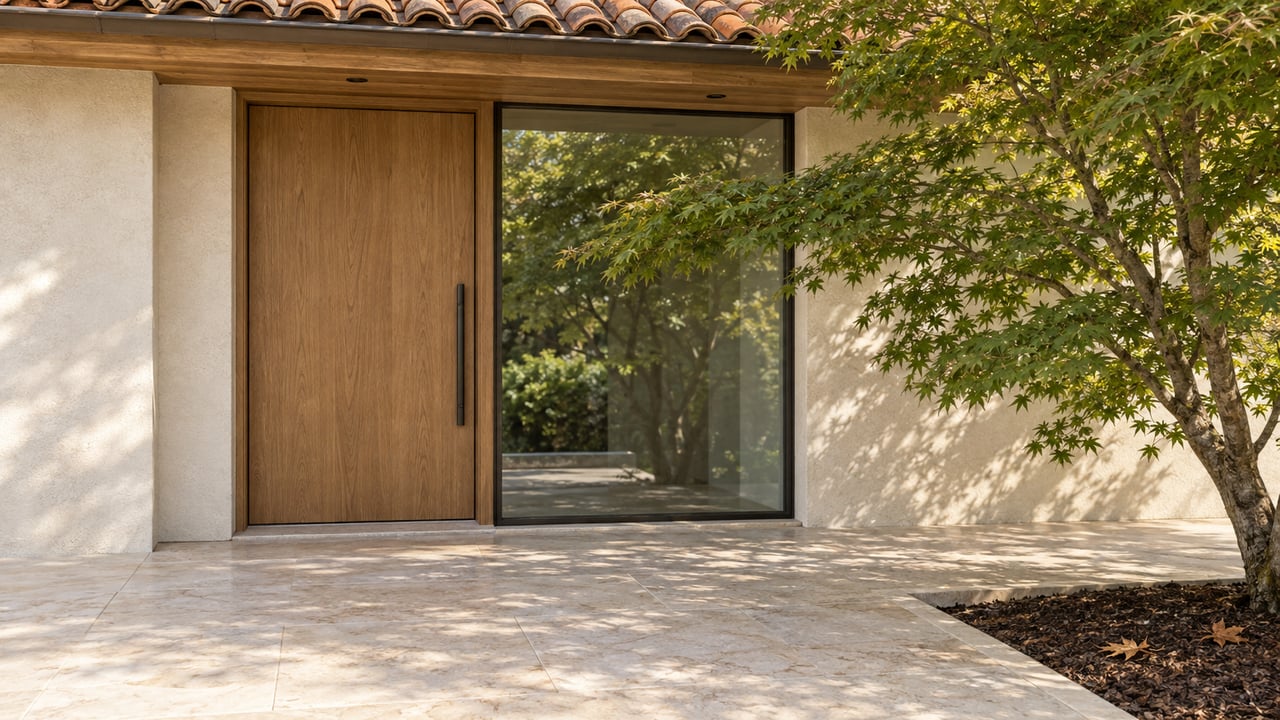
Atherton Train Station Museum: Its History, Funding and Exhibits
October 15, 2026
October 15, 2026
The Town of Atherton will cut the ribbon on the Atherton Train Station Museum on Sunday, October 18, from 2 to 4 p.m. Registration runs through Eventbrite, using a QR code on the Town's event listing. The building is the depot many residents remember from the Fair Oaks Lane crossing. It last took passengers in 2020. The arrangement that ended passenger service is also the reason the museum exists. A Caltrain grant funds the conversion, and the land underneath is still railroad property, which Atherton uses under a license.
Trains had been passing Atherton's platform without stopping long before the formal closure. A January 2020 Town staff report says weekday service ended in August 2005. It gives two reasons: low demand, and a center-platform layout that forced riders to cross the tracks. That layout came with a "hold-out" rule. Whenever a train was boarding at Atherton, trains coming the other direction had to wait.
Weekend service hung on for another fifteen years. The Almanac reported that by the end, trains stopped every 90 minutes on weekends and carried an average of 114 passengers per weekend day. Caltrain's case for closing the station was mostly about operations. It cited the outdated hold-out platform, an estimated $30 million needed to modernize the station, service reliability, and the chance to move that service to Menlo Park and Redwood City. The Caltrain board voted on November 5, 2020, to close the station, and service was set to end that December.
Menlo Park and Redwood City were already the stations Atherton commuters used. The Town's 2020 report notes that Menlo Park handled weekday trains and Redwood City handled Baby Bullet express service. By the time of the vote, the closure mostly made official what riders were already doing.
Atherton negotiated terms before it agreed to the closure. In January 2020, the Town Council told staff to work out a memorandum of understanding with Caltrain. An October 21, 2020 staff report recommended approving that MOU along with a Maintenance and Use Agreement. According to The Almanac, the Council voted 4–1 at the end of October to close the station, pending funding.
The agreement didn't make the depot Town property. The Peninsula Corridor Joint Powers Board, the agency behind Caltrain, bought the railroad right-of-way in 1991 and has operated and maintained the station property ever since. The 2020 arrangement gave Atherton a nonexclusive license to use the station grounds outside the active rail corridor, and made the Town responsible for maintaining that area. The draft agreement set a 20-year term with automatic five-year extensions. It also said permanent improvements would become railroad property.
So the restored building, the dioramas, and the refurbished sign are improvements on land Atherton licenses. The Town takes care of the building and runs the exhibits. The railroad still owns the land.
Caltrain also funded the project. Council directed a $400,000 Caltrain grant to the museum. The Almanac's reporting shows that amount was larger than the construction contract, with design and a short list of extras sitting on the Town's side of the budget.
| Item | Amount | Source and timing |
|---|---|---|
| Caltrain grant directed to the museum | $400,000 | Council direction, reported 2022 and 2023 |
| Original construction estimate | $300,000 | 2022 concept |
| Construction contract, Castillo Plumbing, Inc. of Hayward | $302,000 | Awarded April 19, 2023 |
| Separate design commitment | $96,000 | Reported April 2023 |
| Additional desired work not covered by the grant | About $43,000 | HVAC, monument sign rehabilitation, clock cleaning and repainting |
The $302,000 construction contract fits inside the $400,000 grant. The Almanac's April 2023 report lists the $96,000 design commitment as a separate Town commitment. The roughly $43,000 list covers the building's climate control, its old monument sign, and its clock, and the report says the grant would not pay for that work. None of the sources reviewed for this post give a final total spent.
The 2022 concept, also covered by The Almanac, describes a 620-square-foot museum with a video display, benches, historical exhibits, and a case for model trains. The Town retained Garavaglia Architecture for station design services.
The contract was awarded in spring 2023, and the ribbon cutting comes in fall 2026. The opening date moved several times along the way:
The May report shows what held things up. The building, dioramas, and train models were finished. The interpretive panels were not. The vertical panels had moved into production. The horizontal panels, which go with the dioramas, were still being designed and needed about three weeks of production and installation after approval. The Council's Train Station Subcommittee, made up of Vice Mayor Rick DeGolia and former Councilmember Diana Hawkins-Manuelian, asked the full Council how complete the museum should be before opening, when to hold the ribbon cutting, and how big the event should be.
According to the May 2026 staff report, the finished work includes:
The vertical panels start well before the railroad. They begin with the Peninsula's early peoples and move through the Gold Rush to the San Francisco and San Jose Railroad. The Town's own announcement adds detail that most longtime residents may not know:
"Originally known as Fair Oaks, Atherton's first station began as a simple flag stop on the San Francisco and San Jose Railroad, a railroad built largely by Chinese laborers."
The same announcement describes the station's changes over time. It started as a wood-frame building with a terra cotta roof, became a four-sided glass station, which the Town calls one of the few fully glass-enclosed railroad stations of its time, and by the 1950s was the enclosed depot that later commuters knew. It also says trains on this line helped evacuate thousands of refugees after the 1906 earthquake.
None of the sources reviewed for this post credit a specific curator, model maker, or rail history group with the final exhibits. The May report says only that the panels were developed by the subcommittee and "a designer." The Atherton Heritage Association supplied historical records and photos used in The Almanac's 2020 farewell coverage.
The rail line itself has changed a lot since the station closed. Caltrain's electric fleet began carrying passengers on August 11, 2024, and full electrified service between San Francisco and San Jose, with a new schedule, started on September 21, 2024, according to Caltrain's announcement. Every electric train that has run on the Peninsula has gone past Atherton without stopping. The museum's history runs "from early wood-burning locomotives to today's electric trains," in the Town's words. That means the last chapter covers trains the station never served.
The Town's event listing for the opening doesn't give regular visiting hours or walk-in access rules for after Sunday.
The museum joins a Town Center with a busy fall calendar. On Thursday, October 29, from 3:30 to 5:30 p.m., the Halloween Spooktacular brings library crafts, costume parades through the Police Department, and a scavenger hunt across Town Center. At Jennings Pavilion in Holbrook-Palmer Park, San Mateo County Libraries holds Seasonal Yoga on Thursdays at 11:30 a.m. through November 19. The Atherton Library's Step Into Wellness Walking Club meets there on Fridays from 9:45 to 10:45 a.m., with remaining dates on October 23 and 30, November 6 and 13, and December 4 and 11. The Friends of Atherton Library lists a December tree lighting with cookie decorating in the Heritage Room. The date is still marked "TBC."
Atherton's historic buildings, license agreements, and civic projects all shape what a property here is worth and how a sale goes. Wendy Kandasamy follows these details closely. Schedule a complimentary market consultation and home valuation to talk through how your Atherton property fits in.
This article is general information, not legal, tax or financial advice. Consult a qualified professional about your situation.
Stay up to date on the latest real estate trends.
Leveraging her expertise in both the economics of home ownership and sharp analysis of the real estate market. This unique combination proves invaluable when crafting tailored solutions for her clients' diverse real estate needs
Get In Touch With Wendy To Learn More
Address: 578 University Ave Palo Alto CA 94301