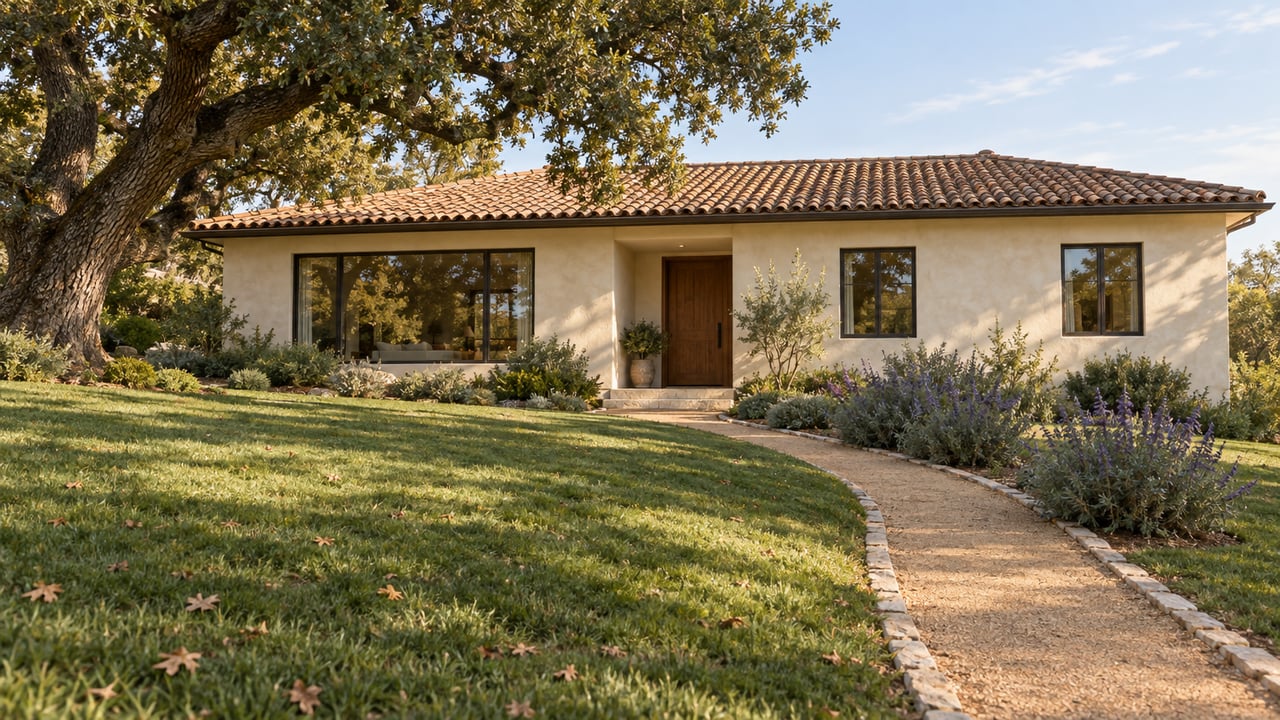
Los Altos Hills Doesn't Have a Downtown. It Has a Barn, a Preserve, and a Telescope.
October 1, 2026
October 1, 2026
On the afternoon of September 5, cars lined the shoulders of Altamont Road on both sides for a stretch outside Westwind Barn. There is no curb to park against, no meter to feed, because Altamont Road doesn't have those things. What it had that Saturday was Capelo's BBQ working a food truck line, Sidesaddle & Co. playing bluegrass under the arena lights, and a rider named Victoria Dye putting a horse through its paces in the upper ring while a crowd leaned on the fence rail. This was the Hoedown, the Town of Los Altos Hills' one big public gathering of the year, held at Westwind Community Barn.
It is worth sitting with what that scene is not. It is not a restaurant patio, not a Main Street block party, not a downtown plaza rented out for the evening. Every other town up and down this stretch of the Peninsula has some version of a commercial strip where the fall calendar plays out. Los Altos Hills has a horse barn on a 15-acre parcel that a Hungarian countess gave to the town fifty years ago.
Los Altos Hills was zoned from the start around large lots and rural character, and that decision shows up in the smallest details of daily movement. There are no sidewalks in the conventional sense. Getting from a driveway to a trailhead means using a network of pathway easements that cross private property, not municipal curb and gutter. There is no retail district. The nearest thing to a commercial anchor sits just across the town line at Foothill College, and even that is a community college parking lot, not a storefront.
This matters for understanding what "something to do" means here. In a town with a Main Street, the fall calendar is a list of restaurant openings and sidewalk events. In Los Altos Hills, the equivalent calendar runs through three pieces of land that were never planned as a town center at all. They became one by accident of philanthropy.
Byrne Preserve sits along the upper stretch of Altamont Road, connected to the town's pathway system on multiple sides. It exists because Albert M. Byrne donated land to the Nature Conservancy and Countess Betty Byrne Dezahara added more of her own, with smaller parcels folded in later through development agreements. Nobody sat down and designed a park here. A family gave away land, and the town inherited a preserve.
The standard loop through it, the Artemas Ginzton Path, runs 3.1 miles with about 505 feet of climbing and carries a 4.6-star rating from more than 850 AllTrails reviews. It threads through bay and oak woodland past the headwaters of Moody Creek, a seasonal stream that joins Adobe Creek on its way to the Bay. The reward at the top is a single oak on a grassy hilltop with a sightline that runs from Stanford to the NASA Ames campus to the water. None of that infrastructure was built for tourism. It was built for a handful of horses that still graze the open pasture sections, because the preserve sits directly against Westwind Barn's fence line.
Westwind itself has its own donation story. Countess Margit Bessenyey bought the property to breed and train Hungarian horses and worked there for years alongside Linda Tellington-Jones, whose training methods are still taught in clinics nationally. In 1976 she gave the site to the town. A 2009 renovation turned it into the facility that hosts today's boarding program and the Hoedown: a dressage court, a jumping arena with a full set of show jumps, a round pen built with padded panels to keep horses from injuring themselves during training. The Los Altos Hills Horsemen's Association still runs pony rides at the spring Town Picnic and staffs a table at the fall Hoedown, the same volunteer group that has been showing up to both events for years.
Byrne closes to the public thirty minutes after sunset under a town ordinance, which is standard for an open space preserve that borders working pastureland. What breaks that rule, on a schedule rather than by accident, is Grassroots Ecology.
A few times each fall, Grassroots Ecology runs a guided night hike through Byrne Preserve using red and ultraviolet light instead of standard flashlights. The point is to see the preserve the way its nocturnal residents do. Millipedes that look plain brown by day glow bright under blacklight. The organization has been chasing sightings of the Western Forest Scorpion on these hikes, a species most people don't associate with a Peninsula hillside, and one that fluoresces blue under UV for reasons researchers still debate. One theory holds that the glow helps the scorpion sense when it's safe to come out. Another is that it functions as a form of built-in sun protection.
Grassroots Ecology has worked in Los Altos Hills since 2014, focused on restoring native vegetation along Moody Creek and controlling invasive plants in the grassland at Byrne, along with smaller efforts at Juan Prado Mesa and O'Keefe preserves nearby. The night hikes are one small piece of that longer restoration project, but they're the piece a resident can actually show up for on a Friday evening in October. Registration runs through Grassroots Ecology's own event calendar, and hikes meet at the Byrne Preserve entrance across from Westwind's parking lot, the same lot that filled with cars for the Hoedown three weeks ago.
A short drive from Westwind puts you in Parking Lot 4 at Foothill College, next to the Krause Center for Innovation. This is the Foothill College Observatory, run in partnership with the Peninsula Astronomical Society, and it has one of the more unusual standing offers in the area: every clear Friday night from 9 to 11 p.m., anyone can look through a 16-inch computer-controlled Schmidt-Cassegrain telescope that's been in operation since 2007. Every clear Saturday morning from 10 to noon, the same facility opens for solar viewing through white-light and hydrogen-alpha filters, which means you can watch sunspots and solar flares in daylight rather than waiting for dark. Both programs are free. Parking runs three dollars.
The observatory also anchors the Silicon Valley Astronomy Lecture Series, six Wednesday evening talks each academic year that have drawn Nobel Prize winners and members of the National Academy of Sciences to a community college campus tucked into a town with no commercial district of its own. The series has run since 1999 and is moderated by Andrew Fraknoi, Foothill's astronomy instructor emeritus. None of this depends on weather cooperating with a festival date or a restaurant securing a liquor license. It depends on a clear sky and whether you feel like driving up the hill.
Put together, the fall texture in Los Altos Hills looks less like an events calendar and more like a set of standing appointments tied to land that was never meant to be a town center:
The Hoedown already happened this year, and it won't come around again until next September. What replaces it isn't a lull. It's the same land doing quieter work, one clear Friday and one guided hike at a time.
There's a reason you won't find a restaurant-boom story about Los Altos Hills the way you will for California Avenue or Santa Cruz Avenue this season. The town never built a commercial core that could boom. What it built instead, mostly by accepting other people's gifts of land and horses, is a version of public life that runs through a barn, a preserve, and a telescope lot rather than a sidewalk.
If you're weighing a property near Byrne Preserve or along one of the pathway easements and want to talk through how the boundary or access actually works before you make a decision, Wendy Kandasamy knows this stretch of Altamont Road well enough to walk it with you. Schedule a complimentary market consultation and home valuation.
Stay up to date on the latest real estate trends.
Leveraging her expertise in both the economics of home ownership and sharp analysis of the real estate market. This unique combination proves invaluable when crafting tailored solutions for her clients' diverse real estate needs
Get In Touch With Wendy To Learn More
Address: 578 University Ave Palo Alto CA 94301