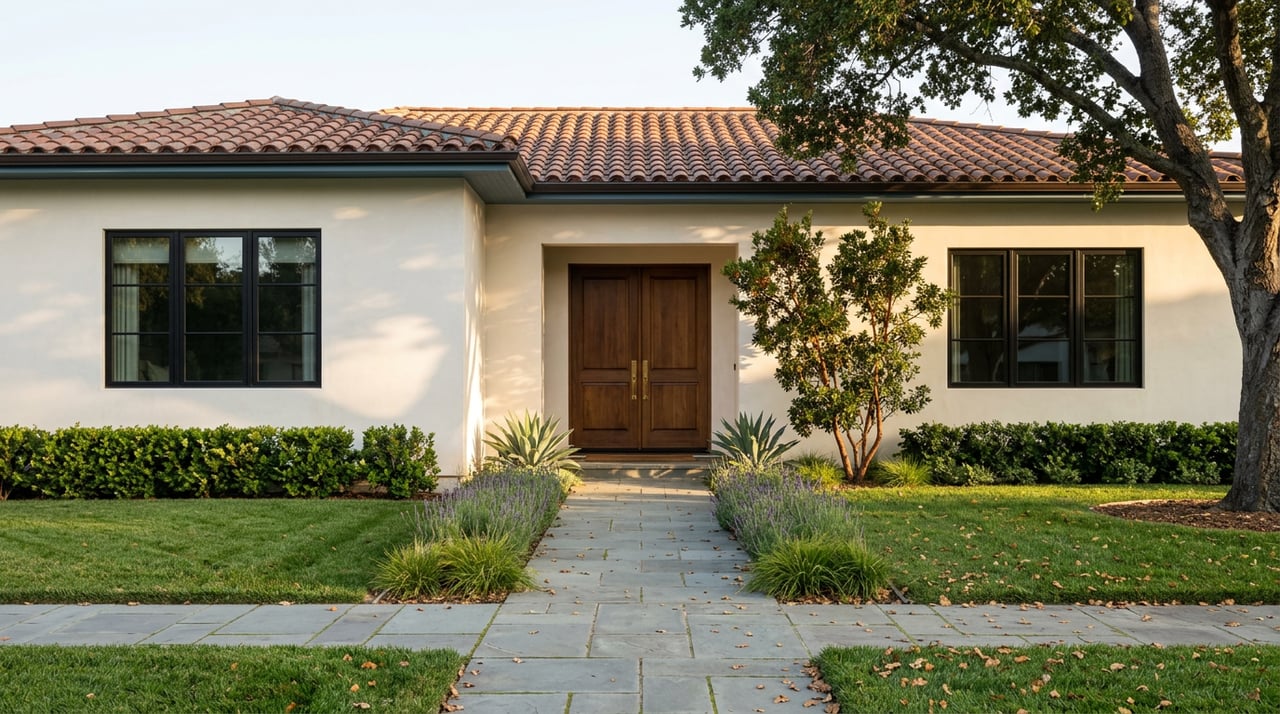
Los Altos Home Prices Are Up 7% and Down 14% at the Same Time. Both Numbers Are Real.
September 17, 2026
September 17, 2026
The clearest illustration of how Los Altos real estate actually prices out isn't even in Los Altos. It's one town over, in Los Altos Hills, in a planning file for a property on Via Feliz. The house being replaced is 3,351 square feet, single story, nothing wrong with it that a hearing packet would flag. The approved replacement is 6,690 square feet, two stories, with a detached accessory dwelling unit and a recreation court. Getting there required removing eighteen ordinary oak trees and two protected heritage oaks. Nobody in that file is arguing the old house was falling down. They're arguing about what the lot is worth once you stop thinking of it as a house and start thinking of it as land with something temporary sitting on top.
That distinction is the whole story behind a number that should be simple and currently isn't: what is a home in Los Altos worth right now.
Over the three months ending in May 2026, the median sale price for a Los Altos home was $4.2 million, down 13.8 percent from the same period a year earlier. That's a straight median of whatever closed escrow in that window.
Over roughly the same stretch, a different measurement told a different story. As of the end of July 2026, the average estimated value of a Los Altos home stood at just over $4.6 million, up 7.0 percent year over year. That figure doesn't come from a median of closed sales. It comes from an index that tries to hold a representative home's characteristics constant and track how its estimated value moves over time, whether or not that specific home ever sold.
Neither number is wrong. They're not even measuring the same thing. One is asking "what did the houses that happened to sell this quarter go for." The other is asking "if the same house existed continuously, what would it be worth today." In most markets those two questions converge closely enough that the gap doesn't matter. In Los Altos right now it doesn't converge, because the mix of what's actually selling has shifted toward older homes bought to be replaced, and a median sale price is defenseless against that kind of compositional shift. A held index tracking value isn't.
You can see the same effect inside a single data provider. Zoom into Old Los Altos specifically, and the three months ending in June 2026 showed a median sale price of $3.7 million, up 6.4 percent year over year, with price per square foot up 9.9 percent. That's the opposite direction of the citywide median over almost the identical window. Same source, same methodology, different neighborhood, different sign on the trend line. The explanation isn't that Old Los Altos is booming while the rest of the city corrects. It's that a median price is only as stable as the mix of homes feeding it, and that mix is not stable right now anywhere in Los Altos.
Ask a builder how they arrive at an offer on a Los Altos teardown candidate and the answer isn't sentimental about the house at all. It's a residual calculation: take the projected value of the finished, new home, subtract construction costs, subtract soft costs like design and permitting, subtract financing, subtract the profit the builder needs to make the project worth doing, and whatever's left is the ceiling on what the land underneath is worth. The existing structure barely enters the equation except as a demolition line item.
That math has real numbers behind it in this market. Land or teardown acquisition alone in Los Altos commonly runs $2.5 million to $5 million or more before a single permit is pulled. New custom construction runs roughly $350 to $600 or more per square foot, against $190 to $425 or more per square foot for a full renovation of the same home. For a 2,200 square foot house, a gut renovation lands somewhere between $715,000 and $935,000. A new build of the same footprint runs $770,000 to as much as $1.32 million. The industry rule of thumb is that once renovation costs climb past roughly 60 to 70 percent of what new construction would cost, the rebuild starts making more sense than the remodel, and foundation condition is usually what tips the decision one way or the other.
Run those numbers against a house like the one on Via Feliz and the logic stops looking cold. The seller wasn't giving up a home. They were selling a site plan wearing a house.
This is where the number stops being trivia and starts mattering to anyone cross-shopping Los Altos against a neighboring city. If you're comparing a Los Altos median to a median in a city with different lot-size minimums, different design review timelines, or a different age profile of housing stock, you're not comparing two markets moving at different speeds. You're comparing two markets where the underlying structure contributes a different share of the sale price to begin with. A city where teardown activity is rare will have a median that tracks house value reasonably well. A city like Los Altos, where a meaningful share of transactions are really land transactions wearing a for-sale sign, will have a median that swings on mix long before it swings on genuine appreciation or decline.
The practical fix isn't complicated. Before comparing a Los Altos number to a number from Mountain View or San Carlos, ask what's actually happening at the lot level in each place. Is the home you're pricing being valued as a house, or is it being valued as a site with a four to eight week permit review process ahead of it and a construction budget still to come. Those are two different products, and no median price line distinguishes between them.
California's SB 9 adds another variable to this same calculation for qualifying Los Altos parcels. Where a lot in the R1 zone meets the city's objective standards, an owner can pursue either a two-unit development on the existing parcel or a full urban lot split into two separate buildable lots, reviewed ministerially without a discretionary hearing. Los Altos applies its own lot coverage caps in that process, up to 35 percent for a single-story structure under 20 feet and 30 percent for anything taller or two stories, and the city has said it will modify those standards where needed to allow two units of at least 800 square feet each with 4-foot side and rear setbacks. For a property that qualifies, the residual land value math isn't running against one hypothetical replacement home anymore. It's running against the possibility of two.
That doesn't mean every older Los Altos lot is a candidate. Eligibility depends on parcel size, frontage, access, and a handful of state and local exclusions, and the city's own SB 9 materials are the place to confirm any specific parcel's status before assuming an uplift that may not apply.
Does every older home in Los Altos sell for land value alone? No. Lot size, zoning coverage limits, foundation condition, and site constraints all affect whether a given house is a genuine teardown candidate or simply a home that needs updating. The residual land value calculation only dominates when the finished-value math clearly outweighs what the existing structure could sell for as-is.
If a value index shows my area rising, why did a comparable house down the street sell for less than last year? Because a rising index and a falling median sale price can both be accurate descriptions of the same market. The index is tracking estimated value for a consistent kind of home over time. The median sale price is only describing whatever actually closed, and if more of what closed recently skewed toward older homes destined for replacement, the median will reflect that mix shift rather than a change in true value.
Does SB 9 change what my Los Altos lot is worth today? It can, but only for parcels that meet the state and local eligibility standards. Before factoring a lot split or two-unit development into any pricing conversation, confirm current standards directly with the City of Los Altos, since objective requirements around setbacks, coverage, and frontage determine whether the added value is real or theoretical for a specific address.
If you're trying to make sense of what a specific Los Altos or Los Altos Hills property is actually worth, the number on a portal is a starting point, not an answer. Wendy Kandasamy can walk through the lot-level math with you and schedule a complimentary market consultation and home valuation built around your specific address, not a citywide average.
Stay up to date on the latest real estate trends.
Leveraging her expertise in both the economics of home ownership and sharp analysis of the real estate market. This unique combination proves invaluable when crafting tailored solutions for her clients' diverse real estate needs
Get In Touch With Wendy To Learn More
Address: 578 University Ave Palo Alto CA 94301